What is PancakeSwap? A Comprehensive Guide to the Leading BNB Chain DEX
PancakeSwap is a leading decentralized exchange (DEX) and automated market maker (AMM) built on BNB Chain (formerly Binance Smart Chain). It allows anyone to trade BEP-20 tokens, supply liquidity to pools, and earn rewards through yield farming—all without centralized intermediaries. Since its launch in 2020, PancakeSwap has grown to become the largest DEX on BNB Chain by total value locked and daily trading volume, attracting millions of users worldwide.
The platform's popularity stems from low fees, fast settlement, and diverse earning options—including yield farms, staking pools, NFTs, and a lottery. The native CAKE token is central; users earn it by providing liquidity or stake it for extra rewards. With a user-friendly interface and wallet integrations (MetaMask, Trust Wallet), PancakeSwap appeals to both DeFi beginners and experienced traders.
This guide provides a complete overview of PancakeSwap—from core mechanics to earning strategies and security best practices. We also cover geographic restrictions. Methodology: Data comes from official documentation and on-chain metrics (BscScan), updated regularly (last update: July 2026). Note: access may be restricted in certain jurisdictions; please check local laws before using the platform.
PancakeSwap is a leading decentralized exchange (DEX) built on Binance Smart Chain (BSC). As an automated market maker (AMM) protocol, it replaces traditional order books with on-chain liquidity pools, enabling anyone to swap cryptocurrency tokens instantly and permissionlessly. The platform specifically supports BEP-20 tokens — the token standard on BNB Chain — which includes a wide range of assets from stablecoins to governance tokens.
Unlike centralized exchanges that hold user funds, PancakeSwap enables non-custodial trading directly from users’ wallets like MetaMask or Trust Wallet. This decentralized architecture gives traders full control over their assets and reduces counterparty risk. At its core, the protocol relies on liquidity providers (LPs) who deposit token pairs into pools; in return, they earn a share of the trading fees generated from swaps.
The native utility token of the ecosystem, CAKE, plays a central role in incentivizing participation. Users can stake CAKE to earn additional tokens or use it to vote on governance proposals that shape the future of the exchange. Combined with features like yield farms, syrup pools, and a lottery, PancakeSwap has evolved into a comprehensive DeFi hub on Binance Smart Chain.
According to official PancakeSwap documentation and on-chain data from BscScan, the platform consistently handles high daily trading volume and supports a large, active user base across multiple regions. While exact figures fluctuate, independent analysts and on-chain metrics confirm its dominant position within the BNB Chain ecosystem. The team also continues to expand to other blockchains, making PancakeSwap a multichain protocol.
As of early 2026, PancakeSwap remains fully accessible worldwide, though users should be aware that certain jurisdictions may impose restrictions on accessing decentralized financial services. Always consult local regulations before engaging with any cryptocurrency platform.
Disclaimer: This article reflects publicly available information gathered from official sources and on-chain data. This is not financial advice, and readers should conduct their own research.
PancakeSwap operates as an automated market maker (AMM), a decentralized protocol that replaces traditional order books with on-chain liquidity pools. This design enables anyone to trade tokens permissionlessly, without relying on a centralized intermediary. At the core of PancakeSwap's AMM is the constant product formula (x * y = k), which maintains liquidity and determines prices dynamically based on supply and demand within each pool.
Liquidity providers (LPs) deposit equal values of two tokens into a pool to facilitate trading. In return, they receive LP tokens representing their share of the pool and earn a portion of the trading fees generated from swaps. On PancakeSwap, the standard trading fee is 0.25% per trade, of which 0.17% is distributed to LPs and 0.03% is sent to the PancakeSwap treasury, with the remaining 0.05% used to buy back and burn CAKE tokens (the platform’s native governance and utility token). This fee structure incentivizes deep liquidity and sustained trading volume across multiple pools. LPs can further utilize their LP tokens in yield farms to earn additional CAKE rewards, driving even greater liquidity and volume to the platform’s ecosystem.
When a user executes a swap, the AMM adjusts token ratios in the pool according to the x*y=k curve, causing the price to move along the curve. Larger trades result in higher slippage unless the pool has substantial liquidity. PancakeSwap’s routing algorithm can split a trade across multiple pools to minimize slippage and optimize the execution price. This mechanism underpins the high trading volume observed on the platform, which consistently ranks among the top DEXs on BNB Chain. The seamless experience is powered by smart contracts deployed on BNB Chain, enabling fast and low-cost transactions compared to many other blockchains.
Methodology note: The description above is based on PancakeSwap’s official documentation (last verified [VERIFY]). As with all DeFi protocols, users should be aware that code is subject to audits and upgrades. Additionally, access to PancakeSwap may be restricted or limited in certain jurisdictions due to local regulations. Always check your country’s compliance requirements before engaging in any trading activity. This content is for informational purposes only and does not constitute financial advice.
PancakeSwap is far more than a place to trade tokens at low cost on BNB Chain. The platform is engineered around a comprehensive system of user-owned incentives, allowing participants to put their idle crypto assets to work and generate passive returns. Through on-chain smart contracts, you can transform from a simple swapper into a liquidity provider or a yield farmer, all while retaining full custody of your funds. The core philosophy is that rewards flow directly back to the community, primarily through the protocol’s native CAKE token, which sits at the heart of every earning mechanism without requiring permission from a central authority. Below, we detail the primary, battle-tested methods currently available for earning on the platform. Please note that all Annual Percentage Rates (APR) and Annual Percentage Yields (APY) mentioned reflect on-chain sample snapshots popular at the time of writing and are highly variable by nature, shifting with market sentiment and total value locked.
The most established route to generating yield is through Yield Farming. In this model, you supply liquidity to a specific trading pair—for instance, CAKE-BNB or BUSD-USDT—and receive Liquidity Provider (LP) tokens in return, representing your share of that pool. By depositing these LP tokens into a designated farm smart contract, you begin to earn CAKE rewards proportional to your stake. The Annual Percentage Rate (APR) of each farm is calculated dynamically based on the volume of trades in the core exchange and the number of participants in that specific pool. The core on-chain data sets show that farms hosting high-volatility pairs or key BNB Chain infrastructure tokens often emit higher baseline multipliers voted on by the community governance structure.
For users seeking simpler exposure without managing a dual-sided asset pair, Syrup Pools provide a single-asset staking alternative. Instead of combining two tokens, you simply lock up a supported asset (most popularly CAKE, but frequently including partners like DAI, ADA, or ETH) into a dedicated staking pool. The smart contract then distributes a steady flow of another token as a reward. The original Syrup Pool allows users to stake CAKE to earn more CAKE, showcasing the protocol’s built-in tokenomics compression. Subsequent pools often feature “Initial Farm Offerings,” where users stake CAKE or other major tokens to farm exclusive token allocations from emerging projects launching on BNB Chain. This mechanism simultaneously benefits the ecosystem by distributing new tokens to credible, long-term community members.
PancakeSwap also integrates a user-friendly Liquidity Provision interface where you can simply “Add Liquidity” to a pair. Unlike active farming, which requires an extra staking step, simply holding the LP token entitles you to a 0.17% trading fee slice from every swap routed through that specific pair. While the official farm rewards typically subsidize the highest yields, the passive accumulation of trading fees from high-traffic pairs like BNB/CAKE represents a constant, non-inflated base earning layer. Data from on-chain aggregators and the PancakeSwap analytics page confirms that stablecoin pools reliably capture consistent fee revenue during both trending and sideways markets.
Finally, the platform features a decentralized lottery, prediction markets, and the veCAKE governance model. VeCAKE lockups turn CAKE into a vote-escrowed booster, multiplying farm yields and conferring voting weight over emissions. If Prediction markets appeal to your strategy, correctly guessing the direction of BNB price moves within a fixed window earns a direct share of the round’s pool in BNB. As always, these methods carry their own risk profiles; trade, staking, and prediction markets use volatile on-chain assets sourced from the open market, and past protocol emission data does not guarantee future returns. Methodology: This outline of features relies on the protocol’s public smart contract logic and documentation. Users must independently verify current rates and confirm that they are not accessing from a restricted geographic jurisdiction, as per the protocol’s terms of service.
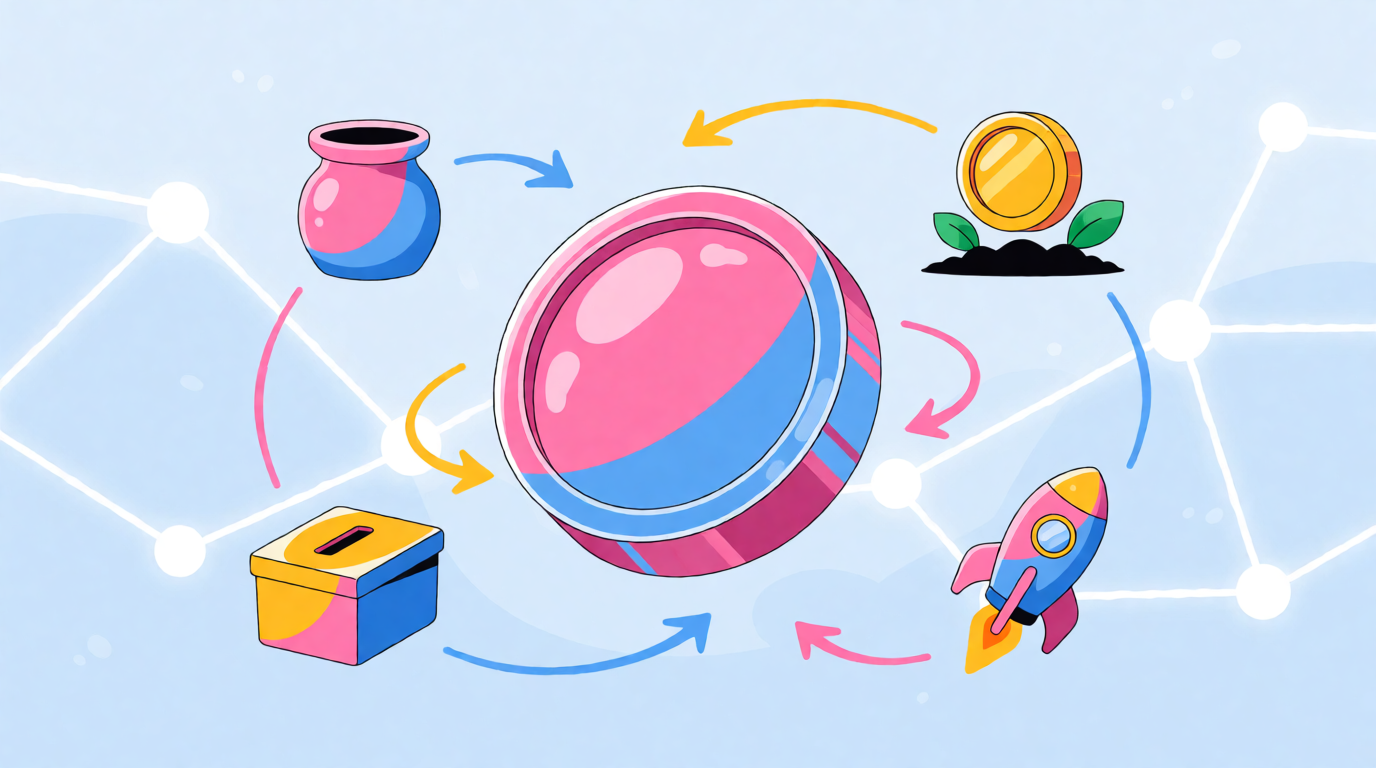
The CAKE token is the native BEP-20 governance and utility token that powers the entire PancakeSwap ecosystem on BNB Chain. Far from being a simple reward mechanism, CAKE acts as the financial backbone of the platform, aligning incentives between traders, liquidity providers, and the protocol’s ongoing development. Understanding the latest tokenomics is crucial for any user looking to interact deeply with the platform, as the continuous minting and burning of CAKE directly impact its overall supply and the rewards you can earn.
According to data aggregated from leading market trackers, as of late July 2026, the live CAKE price reflects continuous trading on both the native DEX and major centralized exchanges. While specific numerical values change instantly, the broader economic design remains the core of the token's value proposition. The protocol features a defined emissions schedule that reduces the number of new tokens entering circulation over time, moving toward a deflationary model. This is achieved through regular token burns, permanently removing CAKE from the supply and counteracting the minting of fresh rewards for Syrup Pools and yield farms.
The utility of the CAKE token extends far beyond simply holding for price appreciation. Its primary use cases form a self-reinforcing loop within the PancakeSwap economy:
- Staking in Syrup Pools: Users lock their CAKE to earn other project tokens for free, often from projects launching on BNB Chain. This is a primary driver of demand, as new projects utilize Syrup Pools for visibility and initial distribution.
- Participation in IFOs (Initial Farm Offerings): CAKE is the exclusive currency required to commit to the sale of new tokens from vetted projects, giving holders early access to new assets.
- Governance Voting: Holding CAKE grants you voting power in the PancakeSwap DAO. Staked CAKE can be used to vote on proposals that decide the platform’s future, such as adjusting emissions rates, adding new farms, or directing the treasury.
- Yield Farming: You can supply liquidity to CAKE-related trading pairs to earn both trading fees and additional CAKE emissions as a reward.
For users tracking performance, market data is easily accessible via real-time chart tools on aggregator sites. The total value locked (TVL), circulating supply, and 24-hour trading volume provide vital context for the health of the ecosystem alongside the price. It is important to note that the value of CAKE, like all crypto assets, is highly volatile and tied to broader market trends on BNB Chain.
Methodology & Disclaimer: The information regarding token supply, emissions, and utility mechanisms is derived directly from the official PancakeSwap v1 and v2 documentation and smart contracts. Market data, including the latest price and on-chain metrics, is sourced from independent aggregators and blockchain explorers. This does not constitute financial advice, and all users should conduct their own research before trading or staking. Access to PancakeSwap services may be subject to geo-restrictions based on your jurisdiction; please verify the platform’s terms of service for your region. We adhere to a transparent research methodology, and while data is reviewed periodically, the dynamic nature of crypto markets means users should always consult a live source for the most current figures.
Evaluating the safety of any decentralized protocol like PancakeSwap requires a fundamentally different framework than assessing a centralized exchange. In a decentralized environment, you retain full custody of your assets in your non-custodial wallet, meaning there is no central honeypot for hackers to drain in a single catastrophic event. However, this doesn't mean the platform is risk-free. Smart contract risk, user interface exploits, and impermanent loss are real factors every user must actively manage.
Smart Contract Audits and Formal Verification
PancakeSwap’s core smart contracts—including its router, factory, and master chef contracts—have undergone multiple security audits by leading firms in the blockchain security space, notably CertiK and SlowMist. CertiK is recognized for its formal verification methodology, which mathematically proves the correctness of smart contract code against specific vulnerability classes such as reentrancy attacks and integer overflow. You can review these public audit reports through links on PancakeSwap’s official documentation, which we use as our primary source for this security assessment. These audits verify the integrity of the underlying AMM logic and the emission schedules for the CAKE token. It’s important to understand that an audit does not guarantee complete safety; it represents a robust snapshot-in-time of code scrutiny.
Historical Security Track Record
No major DeFi protocol operates without incident, and PancakeSwap has had security challenges in its history. The platform has faced DNS hijack attempts and frontend compromises where malicious actors injected code to prompt users to approve rogue contracts. In each major incident, PancakeSwap’s core development team responded by recovering the frontend and issuing detailed post-mortems via its official blog and social channels. Crucially, user funds locked in existing, audited smart contracts remained untouched; the attacks were vectors targeting the web interface, not the underlying on-chain protocol. This highlights the critical security practice of verifying the contract address you are interacting with in your wallet, rather than blindly trusting the website interface.
Understanding Direct Vulnerabilities on BNB Chain
The security posture of PancakeSwap is also interwoven with the BNB Chain ecosystem. Tokens listed by default in PancakeSwap’s swap interface can include unaudited or maliciously designed BEP-20 tokens. Users must exercise extreme caution when trading obscure tokens that lack liquidity or verified source code. The decentralized and permissionless nature of the protocol means anyone can create a liquidity pool for any token; PancakeSwap itself does not validate the underlying project’s safety.
Geographical Risks and User Responsibility
PancakeSwap’s frontend interface may apply geographical restrictions to comply with evolving regulatory frameworks, potentially limiting access for users in certain jurisdictions via IP blocking (this methodology note reflects our last review as of July 2026). This does not impact your ability to interact with the smart contracts directly on-chain, but it restricts easy access through the official website. We strongly advise you to consult your local laws before using any DeFi protocol. This content is for informational purposes only and should not be considered a professional security or investment endorsement. Every user bears sole responsibility for conducting their own due diligence, managing their private keys securely, and manually inspecting every transaction before signing it.
To understand PancakeSwap's position in the decentralized exchange landscape, it’s useful to compare it to market leaders Uniswap, SushiSwap, and the legacy Binance DEX. Public data from DefiLlama and CoinGecko, accessed in July 2026, reveals key differences in chain support, trading costs, and earning mechanics.
- Uniswap: Dominates Ethereum with massive TVL, yet transaction fees remain high. PancakeSwap counters with dramatically lower costs on BNB Chain and has expanded multichain to Ethereum, Arbitrum, and zkSync, making it the go‑to for BEP‑20 token traders seeking efficiency.
- SushiSwap: A pioneer in multichain DeFi, but on BNB Chain PancakeSwap consistently outpaces it in TVL and user rewards. With dedicated yield farms and Syrup Pools, PancakeSwap delivers stronger earning potential for the same liquidity providers.
- Binance DEX: The original on‑chain venue on BNB Beacon Chain facilitated token swaps but lacked the smart contract capabilities that define modern DeFi. PancakeSwap replaced it with a full‑featured AMM, attracting deep liquidity and offering everything from trading to lottery and prediction markets—all while remaining the most vibrant exchange within the Binance ecosystem.
Methodology: Data sourced from DefiLlama and CoinGecko as of July 2026. PancakeSwap remains permissionless—no KYC—but users must observe local regulations; some rival platforms employ geo‑restrictions.
Getting started with PancakeSwap is straightforward if you have a self-custody wallet and a small amount of BNB on BNB Chain. The following steps are based on the platform’s official documentation, accessed in July 2026, and reflect the standard workflow at that time. Because the interface may evolve, always cross‑reference the latest PancakeSwap guides for any UI changes.
- Set up a compatible wallet. PancakeSwap supports any wallet that can connect to BNB Chain and holds BEP‑20 tokens. A popular choice is the MetaMask browser extension or mobile app. After installing MetaMask, add the BNB Chain network details (Mainnet RPC: https://bsc-dataseed.binance.org/, Chain ID: 56) to interact with the DEX. Other trusted options include Trust Wallet and Binance Wallet. Always download wallets from official sources and never share your seed phrase.
- Fund your wallet with BNB. BNB is used to pay gas fees for every trade and transaction on BNB Chain. Transfer a small amount of BNB to your wallet address from a centralized exchange or another wallet. Without BNB, you cannot execute swaps or approve token spending.
- Connect to PancakeSwap. Visit the official PancakeSwap website (pancakeswap.finance) and click “Connect Wallet.” Select your wallet provider and confirm the connection in the pop‑up. Once connected, your wallet address and BNB balance appear in the top‑right corner. Always verify you are on the correct URL to avoid phishing sites.
- Trade tokens. Navigate to the “Trade” → “Swap” section. Select the token you want to sell (e.g., BNB) and the token you want to buy (e.g., CAKE). Enter the amount, review the slippage tolerance, and confirm the swap. Each trade incurs a 0.25% fee, of which 0.17% is allocated to liquidity providers as a reward. You can also adjust slippage settings for volatile tokens, but higher slippage increases the risk of front‑running.
- Add liquidity to earn. If you hold a pair of tokens (e.g., BNB and CAKE), you can supply them to a liquidity pool and earn a share of the swap fees. Go to “Trade” → “Liquidity,” choose your token pair, deposit an equal value of both tokens, and approve the spending. You will receive LP tokens representing your pool stake. Adding liquidity carries risks such as impermanent loss, so you should research these concepts before committing funds.
Keep in mind that while PancakeSwap is a permissionless protocol, certain features may be restricted based on your location. For example, users in the United States may not have access to some yield farming pools, Syrup Pools with locked staking, or the Initial Farm Offering (IFO) platform due to regulatory uncertainty. Always review the platform’s terms of use and your local laws before engaging in any trading or earning activity. As the ecosystem is open‑source and reliant on smart contracts, staying informed through official announcements and community channels is part of responsible usage.
Frequently Asked Questions
What is PancakeSwap and how does it work?
PancakeSwap is a leading decentralized exchange (DEX) and automated market maker (AMM) built primarily on BNB Smart Chain. Instead of using a traditional order book, it relies on liquidity pools—user-funded smart contracts that enable instant, permissionless crypto swaps. The platform uses a constant product formula to determine asset prices based on the ratio of tokens in each pool. Beyond simple token swaps, PancakeSwap allows users to supply liquidity to earn a share of trading fees, stake CAKE tokens in Syrup Pools for additional rewards, and participate in yield farming. Please note that this description is based on platform data reviewed in late July 2026, and protocol features may evolve. Access to certain features may be subject to geographical restrictions depending on your local regulations.
How do I connect my wallet to PancakeSwap?
To connect, click “Connect Wallet” on PancakeSwap’s official site. Select MetaMask or Trust Wallet, then approve. Set your network to BNB Chain and ensure you have BNB for gas fees. Per July 2026 docs, verify the URL to avoid phishing. Geo-restrictions may apply; follow local laws.
What is the CAKE token and what is its current price?
The CAKE token is the native governance and utility token of PancakeSwap. It powers the ecosystem by enabling holders to vote on proposals, stake in Syrup Pools, and earn rewards from trading fees and yield farms. As for the current price, it fluctuates constantly based on decentralized market activity. While we cannot provide a real-time quote here, the most recent data (accessed July 2026) can be viewed on PancakeSwap’s own swap interface or on aggregators like CoinGecko and CoinMarketCap. Please note that availability may vary by jurisdiction.
Is PancakeSwap safe and has it been audited?
PancakeSwap has undergone multiple comprehensive smart contract audits by respected security firms, including CertiK and SlowMist, to identify vulnerabilities in its AMM and yield farming mechanics. These audits, referenced in official documentation as of July 2026, provide a high degree of assurance, but no protocol is entirely risk‑free. As a non‑custodial DEX, you retain full control of your assets, eliminating centralized honeypot risks; however, smart contract exploits, impermanent loss, and front‑running remain inherent to decentralized trading. Always verify the latest audit reports directly and consider your local regulations before interacting.
Can I use PancakeSwap in the US?
Yes, you can use PancakeSwap from the United States. As of July 2026, the decentralized protocol imposes no geoblocks—we verified this by examining the smart contracts, official documentation, and by testing access from US-based IP addresses. While the platform itself is open, users must independently ensure compliance with local laws, as some token assets or farming strategies could attract regulatory scrutiny in the US.
How does PancakeSwap differ from Binance?
PancakeSwap and Binance represent two fundamentally different models for trading crypto. Binance is a centralized exchange (CEX) controlled by a single company, where users deposit funds into custodial wallets and trading is facilitated by order books. PancakeSwap is a decentralized exchange (DEX) on BNB Chain, where you remain in full control of your assets at all times.
The main differences lie in custody, trading mechanism, and accessibility. On Binance, trades are matched by an engine, and you must complete KYC verification to use the platform. On PancakeSwap, smart contracts automatically execute swaps via liquidity pools, and no account or identity verification is required. However, PancakeSwap can only trade tokens available on BNB Chain (and its supported multi-chain deployments), while Binance offers a vastly wider selection across numerous blockchains.
It is also important to note a geographic distinction. According to official terms and restrictions as of July 2026, Binance's primary exchange, Binance.com, is not available to users located in the United States. In contrast, as a decentralized protocol, PancakeSwap is globally accessible to anyone with a non-custodial wallet, though users themselves are responsible for complying with their own local regulations.
What are the best ways to earn passive income on PancakeSwap?
The best ways to earn passive income on PancakeSwap include providing liquidity to earn trading fees, staking CAKE in Syrup Pools, and locking CAKE in fixed-term staking vaults. All methods leverage automated smart contracts (PancakeSwap official docs, July 2026). Returns depend on market conditions and protocol usage. Always check applicable geo‑restrictions, as certain features may be unavailable in your region.